
How do ROV robots navigate underwater?
Leave a message

Underwater exploration and inspection are crucial in various industries, including oil and gas, marine research, and infrastructure maintenance. Remotely Operated Vehicles (ROVs) play a significant role in these activities, allowing us to access and observe the underwater world without the need for human divers in dangerous or hard - to - reach areas. As a reliable ROV robot supplier, we understand the importance of how ROVs navigate underwater effectively and accurately.
1. Sensors: The Eyes and Ears of ROVs
ROVs rely heavily on a suite of sensors to understand their surrounding environment. One of the most fundamental sensors is the sonar system. Sonar works by emitting sound waves into the water. These waves travel through the water and bounce back when they hit an object. By measuring the time it takes for the sound waves to return and analyzing the characteristics of the reflected waves, the ROV can determine the distance, size, and shape of nearby objects.
There are two main types of sonar used in ROVs: side - scan sonar and forward - looking sonar. Side - scan sonar is excellent for mapping large areas of the seabed. It can provide detailed images of the ocean floor, helping to identify features such as shipwrecks, geological formations, and pipelines. Forward - looking sonar, on the other hand, is used to detect obstacles in the ROV's path. It allows the operator to see what lies ahead and make informed decisions about navigation.
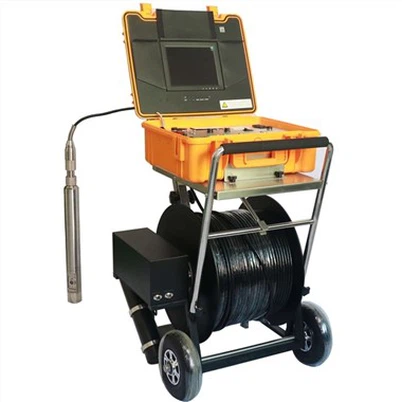
In addition to sonar, ROVs are also equipped with video cameras. Our Drilling Inspection Camera Waterproof 30 Bar and Deep Water Well Inspection Camera Underground Underwater Inspection Camera are high - quality cameras that can capture clear images and videos in the underwater environment. These cameras provide real - time visual feedback to the operator on the surface, enabling them to directly observe the underwater scene and guide the ROV's movement.
Other sensors like depth sensors, compass sensors, and inertial measurement units (IMUs) are also essential. Depth sensors measure the distance between the ROV and the water surface, allowing the operator to control the ROV's vertical position. Compass sensors indicate the ROV's heading, while IMUs provide information about the ROV's orientation, acceleration, and angular velocity. All these data are combined to give the operator a comprehensive understanding of the ROV's position and movement in the water.
2. Propulsion Systems
Propulsion systems are what give ROVs the ability to move underwater. ROVs typically use thrusters to generate the necessary force for movement. These thrusters are carefully designed to work efficiently in the dense and viscous underwater environment.


There are various types of thrusters used in ROVs, such as fixed - pitch thrusters and variable - pitch thrusters. Fixed - pitch thrusters are simple and reliable, providing a constant thrust in a specific direction. Variable - pitch thrusters, on the other hand, can adjust the pitch of the propeller blades, allowing for more precise control of the thrust force and direction.
By carefully controlling the power output and direction of each thruster, the ROV can perform a variety of maneuvers. For example, if all the horizontal thrusters on one side of the ROV are set to a higher power than those on the other side, the ROV will turn in the direction of the weaker - thrust side. Similarly, by adjusting the vertical thrusters, the ROV can ascend or descend in the water column.
3. Navigation Algorithms
The data collected from sensors is processed by sophisticated navigation algorithms. These algorithms take into account all the sensor inputs to calculate the ROV's exact position, velocity, and orientation.
One commonly used algorithm is the dead - reckoning algorithm. This algorithm estimates the ROV's current position based on its previous position, speed, and direction of movement. By integrating the data from the IMU and the propulsion system, the dead - reckoning algorithm can continuously update the ROV's position estimate.
However, dead - reckoning alone has limitations as errors can accumulate over time. To address this issue, ROVs also use more advanced algorithms such as Simultaneous Localization and Mapping (SLAM). SLAM algorithms allow the ROV to create a map of the underwater environment while simultaneously determining its position within that map. The data from sonar and other sensors are used to build a detailed model of the surroundings, and the ROV's position is constantly refined based on this map.
4. Operator Control
Despite the advanced sensors and algorithms, human operators still play a vital role in ROV navigation. Operators are responsible for setting the mission objectives, interpreting the sensor data, and making strategic decisions.
The operator uses a control console on the surface to send commands to the ROV. These commands can include setting the ROV's speed, direction, and depth. The operator also closely monitors the video feed from the cameras and the data from the sensors to ensure that the ROV is operating safely and achieving its mission goals.
In some cases, the operator may need to make real - time adjustments to the ROV's navigation based on unexpected events or new information. For example, if the sonar detects a large obstacle in the ROV's path, the operator can quickly issue commands to change the ROV's course.
5. Communication Systems
Communication between the ROV and the surface control station is essential for successful navigation. A reliable communication link allows the operator to send commands to the ROV and receive data from the sensors.
Most ROVs use a tether cable for communication. The tether cable not only transmits electrical power from the surface to the ROV but also carries data signals. These data signals can include video, sensor readings, and control commands. The tether cable is carefully designed to be strong and flexible enough to withstand the underwater environment and the ROV's movements.
In some cases, wireless communication technologies may also be used, especially for short - range or special - purpose ROVs. Wireless communication can provide more flexibility in the ROV's movement, but it also has limitations such as signal interference and limited range.
6. Applications and Our Offerings
Our ROVs, combined with our high - tech sensors and cameras such as the Best Underwater Sewer Drain Pipe Inspection Video Camera 100m, are suitable for a wide range of applications. In the oil and gas industry, ROVs are used to inspect offshore platforms, pipelines, and subsea equipment. In marine research, they help scientists study marine life, underwater geology, and ecosystems. For infrastructure maintenance, ROVs can be used to inspect and repair bridges, dams, and underwater tunnels.
If you are in need of reliable ROV robots for your underwater inspection or exploration projects, we are here to provide you with top - quality products and professional support. Our ROVs are designed with the latest technology and high - performance components to ensure accurate navigation and efficient operation in the underwater environment.
We invite you to contact us for a detailed discussion about your specific requirements. Our team of experts will be happy to assist you in choosing the most suitable ROV solution for your project. Let's work together to explore the fascinating underwater world!
References
- Fossen, T. I. (2011). Handbook of Marine Craft Hydrodynamics and Motion Control. Wiley.
- Whitcomb, L. L. (2004). Autonomous Underwater Vehicles. Springer.
- Valavanis, K. P., & Vachtsevanos, G. J. (Eds.). (2015). Handbook of Unmanned Aerial Vehicles. Springer.