
What is the maneuverability of an ROV robot?
Leave a message

Hey there! As a supplier of ROV (Remotely Operated Vehicle) robots, I've had my fair share of chats with folks curious about these nifty machines. One question that pops up a lot is, "What is the maneuverability of an ROV robot?" Well, let's dive right in and explore this topic.
First off, maneuverability in an ROV robot is all about how well it can move around in different underwater environments. You see, the underwater world is a tricky place. There are all sorts of obstacles like rocks, coral reefs, and even man - made structures. An ROV needs to be able to navigate through these spaces with ease.
One of the key factors that determine an ROV's maneuverability is its thruster system. Thrusters are like the engines of an ROV. They push the robot through the water in different directions. Most ROVs come with multiple thrusters. For example, a typical ROV might have four or six thrusters. These thrusters can be arranged in different configurations to give the ROV different types of movement.
Let's talk about some basic movements. An ROV can move forward and backward. This is pretty straightforward. The thrusters at the front or back of the ROV are activated to push it in the desired direction. But it's not just about going in a straight line. An ROV also needs to be able to turn. Side - mounted thrusters are used for this. By adjusting the power of the thrusters on one side compared to the other, the ROV can make a turn. It's kind of like how a car turns by steering the wheels, but in the water.
Vertical movement is another important aspect of maneuverability. An ROV needs to be able to go up and down in the water column. This is where the vertical thrusters come in. These thrusters are usually located on the top and bottom of the ROV. By increasing or decreasing the power of these thrusters, the ROV can rise or sink in the water.
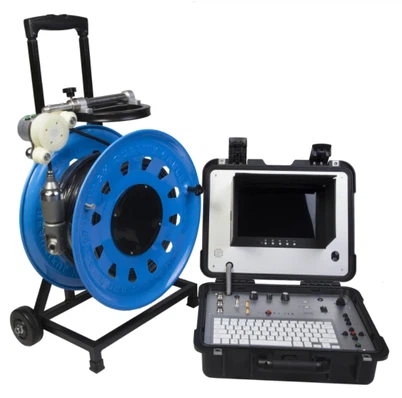
Now, let's think about some real - world scenarios. Say you're using an ROV for underwater inspection. You might be checking out a water well. That's where our 360 Degree Water Well Inspection Camera comes in handy. The ROV needs to be able to move around inside the well, getting a good look at the walls, the bottom, and any pipes or equipment that might be there. It needs to be able to turn in tight spaces and move up and down the well to cover all the areas of interest.
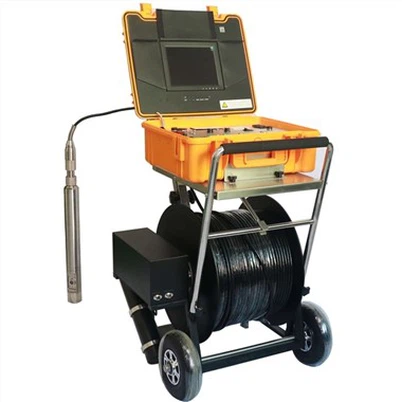
If you're inspecting an underwater borehole, the Underwater Borehole Inspection Camera is a great tool. Boreholes can be long and narrow, and the ROV has to be able to navigate through them. It might need to make slow, precise movements to avoid hitting the sides of the borehole while still getting a clear view of what's inside.
And for borehole pipe inspection, our Borehole Pipe Inspection Camera is a game - changer. Pipes can have bends, joints, and other features that the ROV needs to maneuver around. The ROV has to be able to follow the pipe's path, even when it curves or branches off.
Another factor that affects maneuverability is the ROV's size and shape. A smaller, more streamlined ROV is generally more maneuverable than a larger, bulkier one. Smaller ROVs can fit into tighter spaces and are quicker to respond to changes in thruster power. However, larger ROVs might be able to carry more equipment and have more powerful thrusters, which can be useful in certain situations.
The control system of the ROV also plays a big role in maneuverability. A good control system allows the operator to have precise control over the thrusters. It should be easy to use, with intuitive controls that let the operator make small adjustments to the ROV's movement. Some modern ROVs even come with advanced control systems that use joysticks or touchscreens, making it easier for the operator to navigate the robot.
In addition to the basic movements, some ROVs have more advanced maneuvering capabilities. For example, some ROVs can hover in one place. This is really useful when you need to take a closer look at something or perform a specific task. By carefully adjusting the power of all the thrusters, the ROV can stay in a fixed position in the water.
Some ROVs can also perform what's called "yawing." Yawing is when the ROV rotates around its vertical axis. This can be useful for getting different perspectives of an object or for aligning the ROV with a particular target.
The environment in which the ROV is operating also has an impact on its maneuverability. For example, if the water is very turbulent, it can be more difficult for the ROV to move precisely. The waves and currents can push the ROV around, and the operator has to work harder to keep it on course. On the other hand, in calm, still water, the ROV can move more smoothly and easily.
So, as you can see, the maneuverability of an ROV robot is a complex but important aspect. It determines how well the ROV can perform its tasks in different underwater environments. Whether you're doing inspection work, research, or some other underwater operation, having an ROV with good maneuverability is crucial.


If you're in the market for an ROV robot and are interested in learning more about how our products can meet your needs, we'd love to chat. We have a range of ROVs with different levels of maneuverability to suit various applications. Don't hesitate to reach out to us to start a conversation about your specific requirements.
References
- General knowledge of ROV technology and underwater robotics from industry experience.
- Technical specifications and research on ROV thrusters, control systems, and movement capabilities.