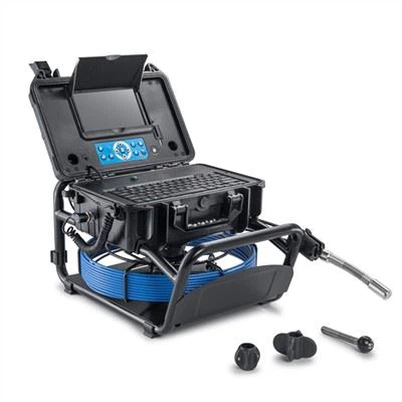

The working principle of the underwater camera photosensitive device CCD
Leave a message
The charge-coupled device image sensor CCD, which is made of high-sensitivity semiconductor material, can convert light into electric charge, and convert it into a digital signal through an analog-to-digital converter chip. The memory or the built-in hard disk card is stored, so the data can be easily transferred to the computer, and the image can be modified according to the needs and imagination with the help of the processing means of the computer. A CCD consists of many photosensitive units, usually measured in megapixels.
When the CCD surface is illuminated by light, each photosensitive unit will reflect the charge on the component, and the signals generated by all the photosensitive units are added together to form a complete picture.
Compared with traditional film, CCD is closer to the way the human eye works on vision. However, the retina of the human eye is composed of rod cells responsible for light intensity sensing and cone cells responsible for color sensing, which work together to form visual sensing. After 35 years of development, the general shape and operation mode of CCD have been finalized. The composition of the CCD is mainly composed of a mosaic-like grid, a condensing lens, and a matrix of electronic circuits at the bottom.
At present, there are mainly two types of CCD photosensitive elements, namely linear CCD and matrix CCD. Linear CCDs, used in high-resolution still cameras, capture only one line of the image at a time, in the same way, that flatbed scanners scan photographs. This type of CCD is highly accurate, slow, and cannot be used to capture moving objects or to use a flash.